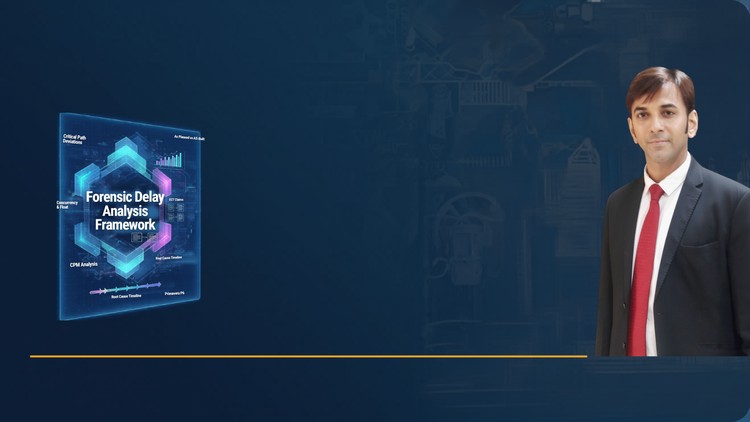
About Course
Most construction professionals analyse delays.
Very few know how courts actually decide them.
This course changes that.
As courts say “no analytical technique commands deference in itself.”
Courts decide delay claims through a legal framework — not through the sophistication of the delay analysis methodology.
What the court weighs is whether the analysis faithfully captures actual causation and correctly applies the legal framework?
This is not an AI voice over course with slides. I actually deliver the course face-to face.
Built entirely on judicial precedent from the TCC Courts In England this course gives you a structured, case-law backed legal framework to do what project managers, planners, and even many lawyers cannot — decide delay claims with the authority and reasoning of a court.
You will learn how courts identify and characterise delay events, how they apportion liability in concurrent delay situations, and how they determine entitlement to Extension of Time (EOT), Liquidated Damages (LDs), and Prolongation Costs — step by step.
This course is for you if you are:
-
A construction lawyer or arbitration counsel handling delay disputes
-
A quantity surveyor or contract manager who needs to build or defend claims
-
An in-house counsel advising on live construction contracts
-
A young lawyer entering construction or infrastructure practice
What makes this different from every other delay course on Udemy:
No scheduling software. No Gantt chart tutorials.
Only the legal reasoning, the leading cases, and a practical framework drawn directly from how courts decide.
Enrol now and start deciding — not just analysing.
I share the complete Forensic Concurrency Matrix — my proprietary methodology developed over 22 years of advising on construction claims. Nothing is held back. The same framework that claims consultants call “a game-changer for structuring expert evidence” and that construction lawyers describe as “immediately applicable in any dispute” is yours.
Across six focused on-demand modules, you will learn to legally characterise concurrent delay, map overlapping events to the critical path, calculate time at risk, build a defensible Extension of Time (EOT) claim, apportion prolongation costs and loss & expense, protect your liquidated damages position and structure tribunal-ready submissions for adjudication, arbitration or court — under JCT, FIDIC and NEC contract forms.
No forensic scheduling background required.
No legal degree needed.
Just a working knowledge of construction contracts and a dispute to resolve.
Join a community who no longer guess delay claims — they prove it forensically.
Course Content
Section 1: The Real Problem — And the Case We Are Solving
-
The Concurrent Delay Problem
10:04
Section 2: Understanding Critical Path and True Concurrency
Section 3: Step 1 — Build The Forensic Timeline
Section 4: Step 2 — Running the Matrix on Project Data
Section 5: STEP 3 Transforming Analysis Into Documents and Decisions
Section 6: Using Forensic Matrix As a Negotiation Tool, Drafting Notices and Pleadings
Student Ratings & Reviews